
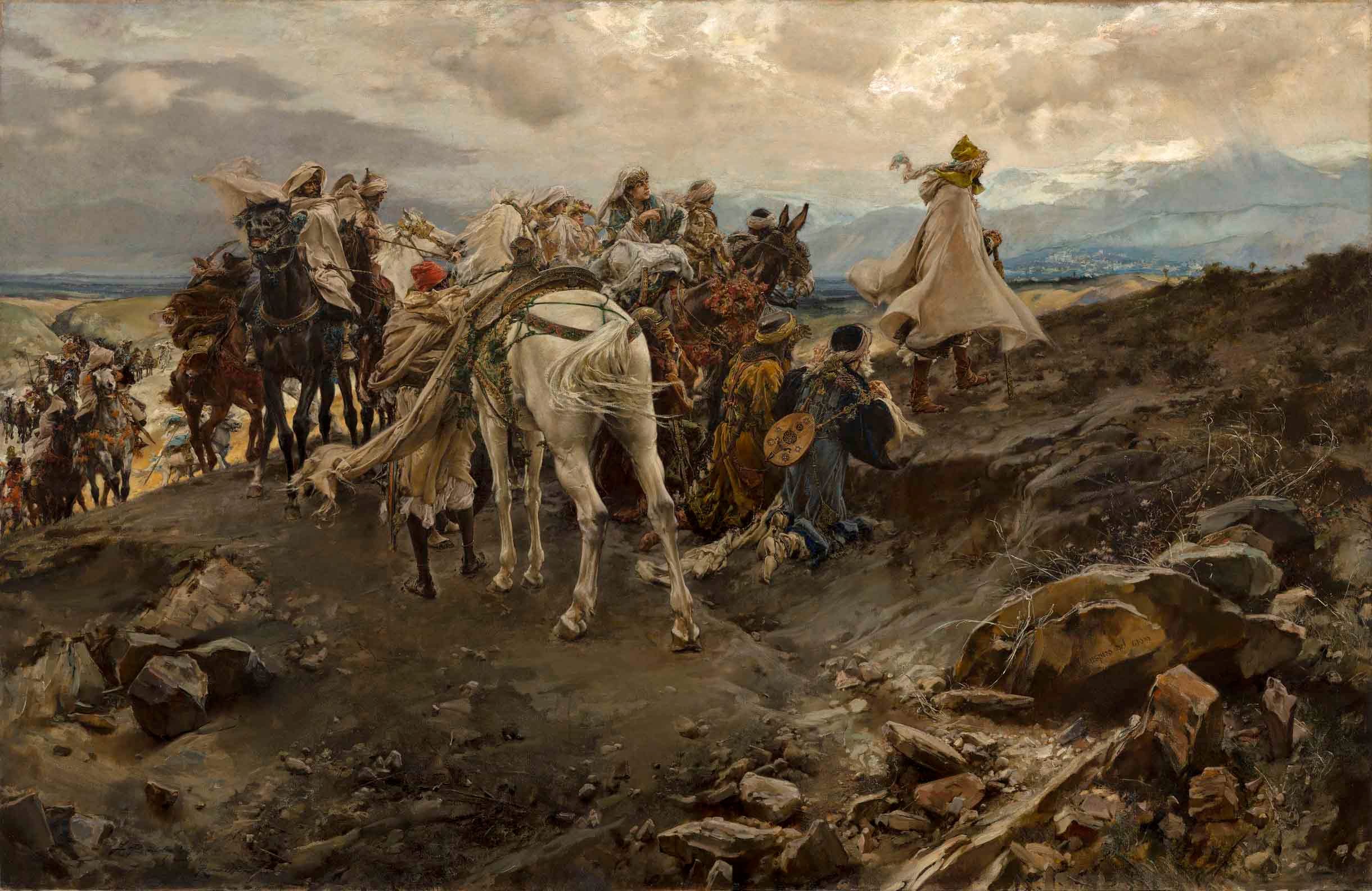
Defeated in war and finally annihilated as a people after their state was wiped off the map in 1492, the Andalusis were to lose in turn their prosperity, their independence, their freedom of worship, their identity, and even the right to live in their ancestors’ land – and, for many, their lives. The tragic fate of the Muslims of the peninsula has never ceased to puzzle historians and observers: how could such a brilliant society, capable of sustaining a state as self-confident and domineering, dare we say, as the Umayyad Caliphate of Qurtubah, have collapsed so miserably to step outside history in heart-rending images of lines of starving and half-naked deportees, forced to leave their homeland under the threat of the tercios’ spears? How can one explain and understand al-Andalus’ gradual collapse, then its complete disappearance, and above all what lessons can be drawn from it for the contemporary Muslim reader? To many, this has seemed quite inconceivable; some have put forward a plethora of political, military, demographic, geostrategic, or technological arguments that we will attempt to summarise and qualify here.
“And obey Allah and His messenger, and dispute not one with another lest ye falter and your strength depart from you.”[1] Obvious as it may seem, there is probably no better illustration of the wisdom of this Qur’anic verse than in al-Andalus’ history. It is certainly a commonplace, but it must be forcefully recalled: fitna, Andalusi Muslims’ millennial curse, was the driving force – transcendent even – behind their world’s extinction and their nation’s annihilation; from the very first decades of the Conquest to the last days of Granada and even beyond, it was always there, irremovable and evil, poisoning souls, disuniting hearts, weakening borders and armies, and opening the door through which the enemy could rush in. Indeed, one cannot fail to notice that each retreat of the Muslims, each success of their enemies, each wave of the Conquista systematically corresponds to a period of troubles and divisions in Dar al-Islam: first power intrigues and the great Berber Revolt prevented ‘Uqba ibn al-Hajjaj from launching his expedition towards the Rhone and thus allowed Charles Martel to take back control of the situation; tribal vendettas between Arab clans caused the fall of Narbonne, the consolidation of the primitive kingdom of Asturias and the depopulation of the “Douro desert”, from which the Muslims were violently driven out; it was during the succession war between al-Hakam and his uncles that Barcelona fell into Frankish hands; the great ethnic fitna between Arabs and Muladis allowed the Asturians to repopulate the no-man’s-land – to make it the historical heart of the Kingdoms of Léon, Castile, and Portugal, from where all future waves of Conquistadors would depart, and to advance their outposts as far as the Douro River. The Qurtubah Revolution, the final fall of the Umayyad Caliphate, and incessant conflicts between Taifa kinglets enabled northern kingdoms to weaken the Andalusis through racketeering and to capture Toledo; civil war between Almoravids and Almohads in Maghreb and the former’s collapse prevented the defence of Lisbon and the Ebro Valley; it was during the anarchy following the collapse of Almohad power that the Castilians, Portuguese, and Aragonese seized 80% of al-Andalus and toppled Seville, Cordoba, the Balearic Islands and Valencia; the betrayal of the Banu Ashqilulah caused the Mudéjar Revolt to fail; a century of intrigues and continuation of fratricidal conflicts until the last years of the Granada War decisively weakened the Nasrid defence; and finally, cabals within the Morisco rebels’ high command confused their allies and hastened their defeat. One could even have started this pitiful account with Musa ibn Nusayr’s and Tariq ibn Ziyad’s recall to Damascus and unjust disgrace, barely three years after the Muslim Conquest – two men whose continued presence in the peninsula would have no doubt produced much better results.
This argument alone, however, could not explain al-Andalus’ ruin. Division sometimes has unexpected consequences, and later European hegemony over the world is often attributed, for instance, to those endless and frequent intra-European wars that had kept these nations in a very offensive and warlike state of mind and led to an unprecedented development of military techniques. The Catholic kingdoms of the North also had their own divisions: quarrels of succession, revolts of the nobility that weakened the monarchy, recurrent tensions between several crowns – Castile, Léon, Aragon, Portugal, Navarre – that sometimes degenerated into open armed confrontations. Nevertheless, several differences can be discerned with terrible intra-Muslim fitnas, at least after the fall of the Umayyad Caliphate: intra-Christian wars were much less violent; each of the rivals sought first and foremost to illustrate his supremacy over his neighbour in his victories against their common enemy – Islam – rather than against his co-religionists, in a sort of conquering competition directed towards the same final goal; the Christians hardly invited the Muslims into their conflicts or onto their lands, did not call on their mercenaries to fight their battles, did not agree to hand fortresses or heavy tribute over to them to help them against their neighbours. Apart from the weak Kingdom of Léon’s ambivalence towards the Almohads for half a century and some modest Nasrid diplomatic manoeuvres, there is no trace of a serious alliance between a Christian power and a Muslim power against another Christian power for 400 years; we know the growing influence of the Pope, the Church, and the spread of Crusade ideology in these major developments. Conversely, masters of deceit such as Ferdinand III of Castile and Ferdinand of Aragon could and did – at the most crucial moments – pull the strings of fitna to push their pawns and skilfully use the opposing side’s disunity to their own advantage.
Beyond that, the fall of al-Andalus is also fundamentally a political failure – for the leaven of division could have been contained, if not extirpated once and for all, by a solid, coherent and just power; this was what the work of the Umayyads was all about – which ‘Abd al-Rahman I had begun with determination and which his eponymous descendant, the third of his name, had brilliantly concluded to lead the country to its greatest golden age, the era of the Caliphate of Qurtubah. However, this fine structure was demolished by the controversial al-Mansur’s delusions of grandeur, who managed to shatter, in just two decades, all the balances patiently built up over the previous two centuries. After the Qurtubah Revolution of 399AH/1009AD, no one seemed able to repair the damage done, and the Andalusis appeared absolutely incapable of agreeing on an adequate political structure – a state that would be powerful enough to be protective but not so powerful as to be oppressive. For more than two centuries, all we see is tinkering: emergence of ephemeral local powers whose princes and lords had no political depth whatsoever, invariably leading to submission to foreign Muslim powers from the Maghreb on the one hand, and to the irresistible advance of the Conquista on the other. When, at last, a relatively sustainable local solution was reborn in the form of the Nasrid Emirate of Granada, it was already too late: al-Andalus had already been reduced to a mere pittance.
The famous Lebanese thinker Shakib Arslan had perceived in al-Andalus’ fate the danger of political isolation and the need for integration of Muslim nations within a unitary Caliphate. This is an issue that deserves to be qualified here – although we do not seek to deny the fundamental idea of the obligation of a supreme political unity of Muslims. In the Andalusi case, integration within transcontinental empires actually created as many problems as it solved; if the irruption of Maghrebi military forces put a temporary halt to the Conquista, it also subjected al-Andalus’ defence to the hazards of the other shore’s internal affairs. Both Murabitun and Muwahhidun remained first and foremost the masters of African empires, who would not hesitate to withdraw their troops and divert the peninsula’s resources to maintain their power in Marrakesh. Faced with this dilemma, the solution would probably have been union with the other shore while keeping solid local structures – both political and military – and a fairly high degree of autonomy. However, their very status as foreign occupiers, and the fact that they only derived the legitimacy of their presence in al-Andalus from their role in the defence of the country in the name of Islam, prevented Amazigh dynasties from promoting the development of a military structure independent of their own forces; this would have been, in a way, an acknowledgement of their powerlessness. This is particularly true of the Almohads, whose culpable role in the fall of al-Andalus could not be overemphasised. After their rebellion had shattered the religious and political unity of the Islamic West, caused the collapse of the Almoravid power and introduced hitherto unknown theological quarrels, the excessive centralisation of their empire had left no room for essential local initiatives and caused paralysis in the peninsula; and the progressive sclerosis of their government had prevented them from taking advantage of the opportunities offered by wavering in Christian lands following the disastrous Battle of al-‘Uqab (Las Navas de Tolosa). Beyond that, the Almohads had shown themselves to be quite incapable of providing an adequate framework, organisation and training to Andalusis who were increasingly determined to take back the struggle against the Conquista in their own hands.
Let us now move, after political failures, to another crucial aspect of the issue: warfare and military affairs. The alleged moral “softness” of the Andalusis, their supposed lack of devotion to their homeland’s defence, and their so-called tendency to “accommodate their northern racial brothers” – all arguments that are frequently evoked by most Western authors to explain their extinction – are to be dismissed at once. The Andalusis’ resistance to the Conquista – from the late Almohad era all the way to Nasrids’ feats of arms and Moriscos’ last rebellions – has been reviewed extensively enough in our book, “The Story of the Andalusis,” to rehabilitate their fighting spirit in the face of the existential threat they faced. The Emirates of Valencia in 1238AD or Granada in 1492AD were not 1940’s France: in the end, the vast majority of Andalusis would prefer to fight to the death or go into exile rather than accept subjugation and forced conversion, and it is only through a full-fledged ethnic cleansing that the Castilians, Aragonese, and Portuguese would finally be able to “pacify” their conquests. “Which nation, we ask”, al-Maqqarî writes on this issue, “among those who recognise the sublime truths contained in the Qur’ân, has shown greater zeal for the Religion, greater willingness to defend its principles, and greater readiness to win the crown of martyrdom? Who on the face of the earth has known a longer, fiercer and more deadly struggle than the Andalusis, who for centuries had to defend the lands inherited from their fathers foot by foot, to irrigate with their blood every inch of ground and to oppose countless swarms of enemy nations that pressed against them relentlessly, like the furious waves of a raging sea? And when, in the end, they had to bow to the irresistible laws of Fate, who could blame them?”[2]
With this in mind, it is no less true that al-Andalus would show a cruel military inferiority when faced with its mortal enemies at crucial moments in its history. It is a political will that is to blame here: the Andalusis’ complete demilitarisation, almost entirely excluded from the armies by al-Mansur in favour of foreign soldiers. While the Umayyads had always maintained a certain balance between native Junds and their external recruits, and their Jihad expeditions still attracted many local volunteers, this policy marked the beginning of a period of military wavering that continued under the Taifas, whose power was essentially based on foreign mercenaries, and to a lesser extent under the Amazigh dynasties, who generally considered – with a few exceptions – that military affairs were essentially their own responsibility. In the end, when the Almohad power collapsed and troops from the Maghreb disappeared, the Andalusis, although enthusiastic and devoted – even exalted – were quite incapable of putting up a professional defence against the Conquista, which made short work of these poorly armed, hardly overseen and barely trained civilian populations. It was then to the rebirth of a genuine native Andalusi military network, overseen by Nasrid rulers, that the Emirate of Granada largely owed its astonishing longevity of a quarter of a millennium. It should be noted here that al-Andalus was somehow ahead of its time – to its great disadvantage. In our era, it can safely be assumed that the Andalusis’ scientific and economic superiority would certainly have enabled them, under the direction of a strong state, to acquire the technological advantage that makes it possible, in the context of modern warfare, to sanctuarize a territory and even to intervene far from its borders – just like today’s Western nations, whose societies are essentially civil and whose populations do not distinguish themselves – except for a tiny minority – by a highly warlike state of mind similar to that of the Conquista.
Here we must say a few words about the enemy’s nature and qualities – a multiple, determined, implacable enemy, united at least outwardly, capable of maintaining an extraordinary aggressiveness from generation to generation. Located in any other part of Dar al-Islam, al-Andalus would undoubtedly have survived despite its flaws; but in the face of such an adversary, it was impossible to commit so many political and military faults without paying a heavy price. From the collapse of the Umayyad Caliphate onwards, it seems that the Conquista’s drive and the commitment of northern monarchies to subjugate the entire peninsula almost never wavered. It was certainly a long-term project, but one that was engraved in everyone’s mind, to which everyone tried to contribute, and in which every ruler wanted to inscribe his name in golden letters – and incidentally expand his own domains. This can be seen in the succession of conquering spearheads – an enterprise carried out in turn by Asturias, Léon, Castile, Navarre, Aragon, and the Catalan counties, Portugal, but also Crusader military orders, urban militias, and feudal aristocracies. In a stark contrast to the Muslim side, the multiplicity of these actors did not seem to handicap the Christian front but, on the contrary, gave it dynamism and vivacity – a definite prowess that is probably to be credited to the propagation of a hard-line Catholic ideology fervently promoted by the medieval Church and its warlike monastic orders. This rather harmonious decentralisation – though not without its tensions – allowed for the development of different driving centres that could regularly take over from each other in the fight against Islâm. It offered a violent contrast with the Muslim side: after the disappearance of the Border Marches, to whom the Umayyads had allowed a certain autonomy in exchange for their defence of Dar al-Islam, it was hard to find a middle ground between counter-productive hyper-centralisation and total anarchy. The extreme militarisation of northern Christian societies was also one of their major advantages in their long-term struggle against the Andalusis: in an environment entirely geared towards war, which promoted the aggressiveness of the male population and trained them from an early age in the use of weapons, the feudal system, the martial organisation of cities through fueros, and the military colonisation of border regions made it possible to mobilise and finance many more soldiers than al-Andalus’ society – marked by a quite modern division between civilians and military – was capable of opposing them; and when all this was not enough, northern kingdoms could always take advantage of reinforcements from Crusaders on their way east or seasoned volunteers from France and elsewhere.
With regard to technology and strategy, the importance of heavy Christian chivalry has certainly been exaggerated, although it undoubtedly had an effect on small, disorganised Andalusi troops; but resounding victories of Zallaqa (Sagrajas), al-Arak (Alarcos), or the Vega of Granada had shown that lighter Muslim armies could stand their ground, and even better – just like the Ayyubids and the Mamluks in the East, from which iron-clad Crusaders were being driven at the same time. Popular ballads show that the Castilians admired fiery and spirited Muslim horsemen just as much as the northern knights were feared. It is actually mainly in siege warfare that the Andalusis and their Amazigh allies or protectors showed worrying shortcomings. While the Umayyads had proved to be very effective in this field, this military know-how seems to have suddenly disappeared from the peninsula after the fall of their Caliphate – without it being clear why. Conversely, northern Christian kingdoms took care to systematically fortify all their conquests and were masters in the art of defending strongholds. Apart from isolated, starving outposts, or castles abandoned by their garrisons, the Conquista would not suffer any major setback: after the Battles of Zallaqa (Sagrajas), Uqlish (Uclès), or al-Arak (Alarcos), for instance, both the Almohads and the Almoravids were unable to recapture Toledo and withdrew quickly after their brilliant campaigns. It was this major weakness that allowed the Castilians to hold their ground and maintain their gains, even when their armies had been soundly defeated in the plains. Finally, the last decisive development in the peninsular balance of power was artillery: it was its massive adoption and coordinated use by the Catholic Monarchs that enabled them to overcome the Emirate of Granada’s powerful defensive lines – although once again, the Nasrid lack of strategic vision in this regard is questionable, since the Muslims had been the first to introduce gunpowder into the country.
The demographic element also seems to have played a certain importance. As we have seen throughout our book, “The Story of the Andalusis,” the Conquista was as much about military conquest as it was about settlement, colonisation and “great replacement”. In view of the relative numerical evolution of Muslim and Christian populations throughout al-Andalus’ history, it seems that the rough northern societies had an extraordinary birth rate: it was this demographic pressure that drove inhabitants of the overpopulated mountains of Asturias, Galicia, or the Pyrenees to rush to the plains and colonise the former “Douro desert”, and that made them as many new soldiers. Conversely, the disastrous impact of the Black Death, which killed up to four fifths of the Christian population, was a major setback for the Conquista, as Castile was no longer able to provide enough men-at-arms to hold its borders. However, this Christian excessive natality was by no means the decisive factor: sometimes, as after the fall of the Guadalquivir Valley, northern powers also ran out of manpower and had to call in Christian settlers from France, Italy, and beyond, so surprised did they seem to be by their conquests’ scale and speed. More decisive seems to have been systematic devastation of border regions and Muslim countryside, which caused ruin, famine, epidemics, and waves of constant emigration towards the North African shore: it must be remembered that during the last five centuries of al-Andalus, if the Christian population was certainly multiplied by three or four, numbers of Muslims were also divided by ten. A vicious circle began, a methodical nibbling that saw the Andalusi populations harassed by enemy raids flee their lands, thus leaving the field open to new Christian military settlers who would repeat the same strategy again and again – until the conquest was completed.
To all these factors, we can add an undoubtedly paramount element: some Muslim leaders’ major faults. In the dock, let us mention al-Mansur’s unquenchable thirst for power who depleted the country’s resources, decimated its elites and, through a futile all-out war, made northern kingdoms their visceral enemies; two centuries later, the Muwahhidun’s dogmatic intolerance that shattered Andalusi way of life and age-old coexistence, alienated the people – both Sunni Muslims and dhimmis – and imported inappropriate religious quarrels in a society that had until then harmoniously combined dominant Maliki Sunni orthodoxy with respected Jewish and Christian minorities. Taifa kinglets’ and the last Nasrids’ frivolity, their total lack of long-term vision, their incorrigible tendency to betray their own for crude worldly interests, must also, of course, prominently figure in the list of the causes of the disaster. Ibn Sa’id added to this the Umayyads’ successors’ lack of credibility, as well as the weakening of the scholars’ role and of justice, the cornerstone of any society – although this must be qualified, depending on the period and the ruler: “It is well known that the strength and solidity of the empire of al-Andalus essentially rested on the policies pursued by its princes, the lustre and splendour with which they surrounded their Court, and the awe they inspired in their subjects, the inexorable rigour with which they repressed aggressions against their power, the impartiality of their judgements, their strict respect for Islamic Law, their attention to the scholars, whose opinions they respected and followed, whom they invited to their meetings and councils, and many other brilliant qualities; for example, every person summoned by a judge – be it the Caliph, one of his sons or a courtier – had to appear in person in court out of respect for the Law. It was when this salutary fear of power and impartial justice vanished that decadence began, followed by complete ruin. As long as the dynasty of the Banu Umayya occupied the throne of Qurtubah, ‘Abd al-Rahman’s successors strove to inspire their subjects with love and respect for their person.”[3]
Persistence of destructive divisions, inability – at least during the two decisive centuries that separated the Umayyads from the Nasrids – to generate a sustainable and coherent political and military model, some rulers’ blunders, mistakes or carelessness in the face of a vigorous, unscrupulous, undaunted enemy with a well-honed strategy: all in all, here is a summary of the main reasons behind the cataclysm. Where shall we place the great turning point, the point of no return? We have seen that the fall of Toledo and its province, the peninsula’s strategic heart, had put al-Andalus in an untenable position, opening its great plains to all enemy raids; but the Muslims had then regained geographical coherence within the small Emirate of Granada, endowed with effective natural borders. In any case, the fall of Toledo was but a logical consequence of the Taifas’ weakness – Taifas that had themselves arisen from Qurtubah Revolution and the Umayyad Caliphate’s disintegration, following imbalances caused by al-Mansur’s turbulent era; but to credit al-Mansur’s sin of pride for the whole decay of al-Andalus would certainly be simplistic – although he himself expressed, on several occasions, fears about his rule’s consequences. There would be many other missed opportunities to take back control: let us just think of the Almoravid impetus broken by the Almohad revolution in the Maghreb, or of succession crises in Castile and Aragon that were not exploited. Allah had decided otherwise.
If al-Andalus had finally succumbed to the Conquistadors’ blows, its prolonged resistance had nonetheless had a major impact on history. For while waves of fighters from Maghreb had not ceased to cross the Strait over the centuries, the continued Muslim presence in the peninsula had also long served as a shield against the predatory threat of rising northern forces. It was only after the fall of Granada that the Spaniards could set out to conquer the African shores; before that, only the Portuguese – who had already completed their “share” of the peninsula’s Christian conquest – had been able to establish a lasting presence there. Had Granada fallen a quarter of a millennium earlier, only Allah knows what might have happened to North Africa – and beyond. Whatever the case, it was now on the other side of the Mediterranean that the Conquista’s battlefield would move; a new epic struggle in which exiled Moriscos, Ottomans, local dynasties, Arab and Amazigh tribes, European “renegades” and privateers would unite to preserve Dar al-Islam from the oncoming flood. But this is another story.
[1] Qur’an, al-Anfal (8/46).
[2] Al-Maqqari in: “Nafh al-Tib”.
[3] Ibn Sa’id, quoted by al-Maqqari in: “Nafh al-Tib”.