
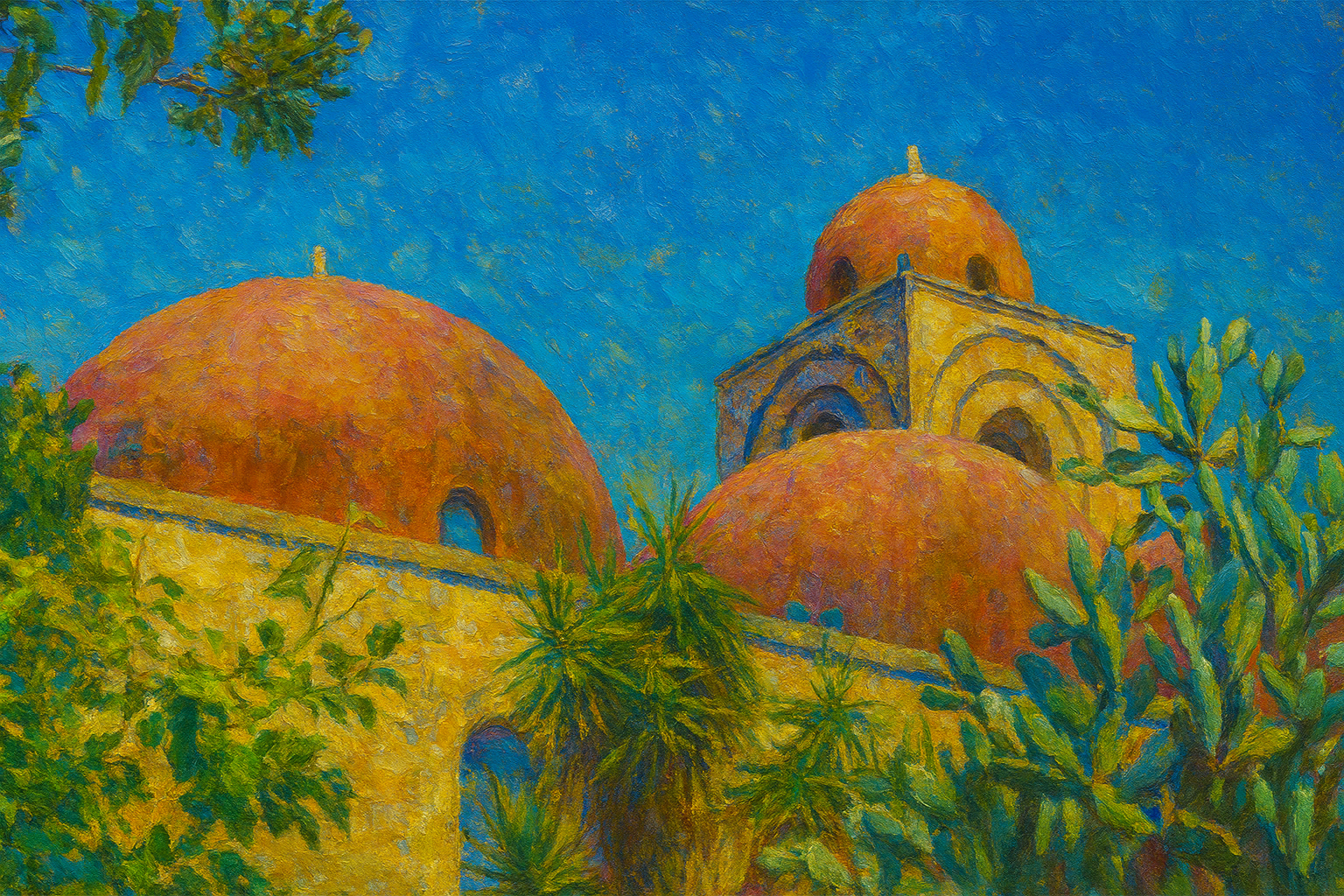
While the Muslim presence in the Iberian Peninsula is now familiar to all, the history of Islam in Sicily — the largest island in the Mediterranean — remains far more obscure. How many could say that the followers of the final Revelation ruled there for more than a quarter of a millennium (831–1091 CE / 215–483 AH) and lived on the island for four full centuries, from the conquest to their final expulsion? How many know that Palermo was once among the most dazzling metropolises of Muslim Europe and of Islamic civilization as a whole; that the kingdom of the markedly Arabophile Norman rulers of Sicily became one of the principal gateways through which the knowledge of the East entered the European continent; or that Arab cultural influence still lingers today in the Sicilian dialect, in place-names, cuisine, agricultural methods, and even architecture?
A Frustrating Conquest
A natural command post over the Mediterranean and the maritime routes linking Europe to Africa and East to West, strategically placed Sicily had — since time immemorial — been the object of ambition and fierce competition among the great powers of each era. Greeks and Phoenicians, Carthaginians, Romans, and Ostrogoths had all settled there in turn, shaping it into the fertile, relatively prosperous island with a flourishing urban life that it remained on the eve of the Muslim conquest. Despite having borne the yoke of Rome for six centuries, the island preserved its Greek language and culture; and since Justinian’s imperial reconquest in the sixth century, it had been governed from Constantinople by those we now call the Byzantines. Its central position, poised between the two basins of the Mediterranean, made it a possession of supreme importance for any ambitious power seeking uncontested dominance over the Mare Nostrum. It was also the ideal springboard toward the promising lands of Italy and the Adriatic coast.
Thus, when the young Islamic state rose from the sands of Arabia and drove the Byzantines back on all fronts — seizing Syria and Egypt, pressing deep into Anatolia, and expelling Eastern Rome from North Africa — it was not long before the sails of the caliphal fleet appeared on the horizon, just beyond Sicily’s idyllic shores… Barely one hundred miles from the Tunisian coast — where caliphal troops razed Carthage to its last stone in the year 78 AH (698 CE) and swiftly established a vast new naval base in Tunis — Sicily had already endured two fleeting raids by those enigmatic conquerors from the East who, having only just appeared on the map of the world, already seemed intent on carrying the message of the final Revelation to the ends of the earth. The first raid came in 31 AH (652 CE), when Mu‘āwiya, then governor of Damascus, obtained Caliph ‘Uthmān’s permission to venture onto the sea. The second took place in 48 AH (669 CE), when a fleet of two hundred ships sailing from Alexandria sacked Syracuse before returning with equal haste to the banks of the Nile.
The growing dominance of the Muslim navy — together with the completion of the conquest of North Africa, a thorn in the Umayyads’ side for decades — by the renowned Mūsā ibn Nusayr, at last made a northern expansion conceivable. Sicily, after all, had long served as Byzantium’s forward base against the Islamic armies operating in Ifrīqiyya and the Maghreb. Pantelleria, lying midway between Africa and Sicily, was thus conquered around 80 AH (700 CE), but internal disputes once again delayed any serious Sicilian campaign. Islamic authorities instead opted to negotiate a commercial treaty with Byzantium, under which Muslim merchants were now permitted to trade in Sicilian ports.
This uneasy peace proved short-lived. Beginning in 109 AH (728 CE), Umayyad governors in Kairouan launched yearly raids against the neighbouring island, culminating in the great expedition of 122 AH (740 CE), led by Habīb ibn Abī ‘Ubayda al-Fihrī — the grandson of the famed ‘Uqba ibn Nāfi‘, conqueror of the Maghreb — during which Syracuse was once more taken. Yet just as he stood poised to seize the entire island, within reach of the triumph that would place his name alongside that of his illustrious grandfather, Habīb was compelled to return in haste to the African mainland: the Great Berber Revolt had just erupted. Thirteen years later, a new expedition led by his son, ‘Abd al-Rahmān, would fail for the same reasons.
Sensing the moment of weakness in the lands of Islam — brought on by ethnic upheavals in North Africa and by the chaos of the Abbasid Revolution that was then convulsing the East — the Byzantines took advantage. They rebuilt their strength, dispatched a powerful fleet to defend their distant holdings in Sicily and Sardinia, repaired their ports, and erected a chain of coastal fortifications in southern Italy. These resolute measures would deter any further Muslim attempts to conquer Sicily for the next half-century. Indeed, the Muslims even found themselves briefly forced onto the defensive, erecting ribāts — frontier fortresses — to shield the African coasts from increasingly frequent and devastating Byzantine incursions.
Order returned to Ifrīqiyya with the rise of the Aghlabid dynasty under the caliphate of Hārūn al-Rashīd, who appointed Ibrāhīm ibn al-Aghlab (193–196 AH / 800–812 CE) — the son of an Arab officer from Khurāsān — as the semi-independent ruler of Abbasid North Africa, governing from his capital at Kairouan. Though he renewed the treaty with Byzantium to encourage maritime trade, his two sons, ‘Abd Allāh (196–201 AH / 812–817 CE) and Ziyādat Allāh (201–223 AH / 817–838 CE), did not share their father’s pacifism. No sooner had the first ascended the throne than he launched an ambitious naval construction program and a first attempt to invade Sicily — an endeavour that all but died at birth when his ships were destroyed by the combined harassment of Italian fleets and a sudden storm. Yet one strategic possession was nevertheless secured: the island of Lampedusa, a new foothold for the forces of Islam in their northward expansion.
A few years and several aborted expeditions later, it was Ziyādat Allāh who had the honour of launching the true conquest of Sicily, in the year 211 AH (827 CE) — a campaign that would take seventy-five long years and end only in 289 AH (902 CE). As in the Iberian Peninsula a century earlier, it began with a theatrical tale of forbidden love. Euphemios, commander of the Byzantine fleet in Sicily, had apparently become so enamoured of a nun that he compelled her to marry him, in flagrant violation of every norm. In Constantinople, this sacrilegious act greatly displeased Emperor Michael II, who, in a rage, ordered the island’s governor, General Constantine, to annul the marriage at once, arrest the culprit, and slice off his nose for good measure.
Naturally, Euphemios had anticipated the imperial reaction. With the support of his loyalists, he soon rose in rebellion, seized Syracuse, had his rival Constantine executed, and proclaimed himself emperor. His adventure in sedition, however, was short-lived: betrayed by one of his soldiers — a certain Balata, who defected to the imperial side — and pressed by an expeditionary force of loyalist troops hastily dispatched from Constantinople, Euphemios found himself with no choice but to abandon his imperial pretensions and flee… to Ifrīqiyya, into the hands of Byzantium’s sworn enemy: Ziyādat Allāh, the Aghlabid ruler of Kairouan.
Still convinced that Destiny was beckoning him, Euphemios offered Sicily on a platter to his host in exchange for nothing more than a general’s rank and personal protection. The emir, in his magnanimity, offered something better still: the right to rule Sicily in the name of the Aghlabids, in return for an annual tribute. Indeed, the renegade Byzantine’s proposal could not have come at a better moment. Beset by a mutinous army — he had only just crushed yet another rebellion — and by defiant Maliki religious elites who decried the luxury of his lifestyle and the un-Islamic taxes he imposed on the populace — not to mention the incessant ethnic tensions between Arabs and Berbers — Ziyādat Allāh saw in this opportunity the perfect outlet for redirecting the martial energies of his troops and the fervour of his scholars toward a target other than himself. In addition, the conquest of Sicily might well secure his place in the grand sweep of history, for it would be the first major campaign of offensive Jihād in the West since the halt of expansion beyond the Pyrenees a century earlier — and in any case, it promised to be an undeniable source of wealth.
The hesitations of the shūrā were swiftly swept aside by the fiery exhortations of the most revered religious figure in Kairouan: Qādī Asad ibn al-Furāt (141–212 AH / 759–828 CE). Despite what was, for his time, an advanced age — seventy years — he remained a towering monument of learning, piety, and eloquence, unmatched in popularity. A native of Harrān (in modern-day Turkey), he had studied under Mālik ibn Anas in Madinah and under the personal disciples of Abū Ḥanīfa — Muḥammad al-Shaybānī and Abū Yūsuf — in Kufa, before returning to Kairouan, where he authored the authoritative legal treatise al-Asadiyya and assumed the office of judge.
Following the model of ‘Umar ibn al-Khattāb — who had made a habit of appointing Companions of the Prophet combining religious stature with leadership qualities to command the armies of Islam — Ziyādat Allāh appointed Asad ibn al-Furāt as commander-in-chief of the expedition. This served both to bolster the morale of the troops and, more Machiavellianly, to rid himself of a man unafraid to challenge authority and publicly denounce its lapses in Islamic ethics.
Before the Muslim expeditionary force gathered at the newly rebuilt ribāt of Sousse, Asad ibn al-Furāt — who had never in his life borne a sword — delivered a speech that drew far more on the exhortations of scholarship than on martial rhetoric:
“There is no divinity but Allah, and He has no equal! O soldiers, I swear by Allah: I have inherited this command from neither my father nor my grandfather, and none of my ancestors ever witnessed a gathering such as this! I am present before you for no reason other than the pen” — that is, through his learning alone. “I therefore urge each of you to spare no effort in the pursuit of knowledge! Be steadfast and patient before every trial that confronts you, for through them you shall attain the good of this world and of the Hereafter!”
Be that as it may, it was at the head of a well-armed force — ten thousand infantry and seven hundred cavalry: the Arab jund of Ifrīqiyya, volunteers from Amazigh tribes and from among the Maliki jurists, Andalusian muladīs likely fleeing the recent revolt of Córdoba’s suburbs, wanderers of the Mediterranean, and perhaps even a few Persians from Khurāsān — borne across a hundred ships, that Asad ibn al-Furāt landed at Mazara del Vallo in the spring of 211 AH (827 CE). There he united with the rebel troops of Euphemios to inflict a first defeat on the Byzantine loyalists and sweep, like an unstoppable tide, across the entire southern coast of Sicily, forcing the hapless Balata to flee to the mainland.
Syracuse — a metropolis that Cicero had described a few centuries earlier as “the greatest and most beautiful of the Greek cities” — soon lay within the grasp of the soldiers of Islam. Its Byzantine notables feigned willingness to pay the jizya and acknowledge the authority of the Caliph. Yet this was nothing more than a ruse designed to buy time to reinforce their fortifications and fill their granaries before reneging on the agreement. Asad ibn al-Furāt was thus compelled to lay siege to the city — a siege that bogged down and dragged on. A year later — after suppressing a mutiny and repelling a Venetian fleet led by the Doge himself — it was finally a sudden epidemic that broke the Muslims’ resolve and forced them, decimated and exhausted, to lift the siege.
To the Aghlabid forces withdrawn to their first stronghold at Mazara del Vallo, it felt as though everything had to be started anew. Asad ibn al-Furāt himself had succumbed to the illness, as had much of his army, while Euphemios — who, it appears, had once again conceived the idea of changing sides — fell in battle beneath the walls of the fortress of Enna (formerly known as Castrogiovanni, or Qasr Yāni’). Yet the Byzantines were in no better condition: pressed at sea by the Andalusis of Crete and on land by the Abbasids, they were incapable of offering any meaningful military assistance to their distant Sicilian province.
The Muslims, by contrast, could rely on massive reinforcements from Ifrīqiyya and al-Andalus. Indeed, it was the unexpected arrival, in the summer of 214 AH (830 CE), of an Andalusi corsair fleet led by an Amazigh admiral named Asbagh — accompanied, we are told, by 30,000 new North African volunteers — that enabled the Sicilian expeditionary corps to resume the offensive. By the autumn of 215 AH (831 CE), the Muslims achieved their first major triumph: the capture of the great city of Palermo — an ancient settlement founded by the Phoenicians some fifteen centuries earlier, thereafter known as Balharm — or more commonly al-Madīna, so beloved would the new capital of Islamic Sicily soon become in the hearts of the region’s inhabitants, supplanting Syracuse.
By skilfully exploiting Sicily’s deposits of naphtha and sulphur, the Muslims made increasing use of incendiary weapons, which allowed them to gain the upper hand at sea over a Byzantine power overwhelmed by events and beset with open fronts along nearly all its borders. Thus, with scarcely any serious opposition — save for a few modest, hopeless relief expeditions — the western third of Sicily, known as the Val di Mazara, passed into the orbit of Islamic civilization. Responding to the appeal of Duke Andrew of Naples, embroiled in conflict with his feudal rivals, Muslim forces even set foot on the Italian mainland itself, where they threatened Rome, seized control of territory in Calabria, and founded the short-lived Emirate of Bari[1], which survived for nearly a quarter of a century (232–257 AH / 847–871 CE).
In 244 AH (859 CE), the powerful Byzantine stronghold of Enna, in the very heart of Sicily, fell to the general and governor al-‘Abbās ibn Fadl. Until then, it had been the principal bulwark preventing the Muslim advance into the eastern half of the island. This resounding victory was celebrated as far as Baghdad, where numerous Byzantine captives were sent to the Abbasid caliph al-Mutawakkil to proclaim to the world the triumph of the Aghlabids. From that moment onward, the Byzantines would no longer be able to challenge the Muslim presence in Sicily.
Far from the relative ease of the earlier advance, however, the conquest of the island’s eastern half would prove long, chaotic, and exacting. There would be no grand, sweeping campaigns orchestrated by tactical geniuses, no pitched battles to stir the imagination — but rather a drawn-out war, devoid of glory and heroic feats, marked by a succession of thankless assaults on citadels, raids designed to exhaust the enemy countryside, the suppression of Christian revolts quietly encouraged by Byzantium, and internal tensions among the various factions of the Islamic army — Arabs, Amazigh, and Andalusis.
At sea occurred the sole striking event of the period: the capture of Malta, which fell into the hands of the Aghlabid prince Ahmad al-Habashī in the summer of 256 AH (870 CE). This was a strategic victory of the highest order, for it completed the maritime encirclement of what remained of Byzantine Sicily and made it easy to block any reinforcements from Constantinople. On land, Muslim pressure mounted as the years went by, and serious hostilities resumed in the summer of 263 AH (877 CE). They culminated in the second siege of Syracuse, which finally fell on 15 Ramadān 264 AH (21 May 878 CE). This time, the definitive expulsion of the Byzantines from Sicily —reduced now to a narrow coastal strip and a handful of strongholds around Taormina in the northeast —seemed only a matter of form.
But this was without reckoning with the perennial fratricidal quarrels among the Muslims, this time fuelled by rival princes. Barely had the victorious general Ja’far ibn Muḥammad subdued Syracuse when he was assassinated by his own slaves, in a plot orchestrated by his uncle and even his own brother. They seized his authority, only to be overthrown and executed in turn. Political instability and the military setbacks that followed — particularly at sea — kindled growing discontent among broad segments of the Muslim troops in Sicily, until then kept in line by the promise of plunder. Before long, this discontent erupted into open rebellion and even a low-intensity civil war. Arabs against Amazigh, Palermo against the other provinces, Sicilian-born Muslims against new arrivals from Ifrīqiyya, the masses against the elites: the prevailing chaos, coupled with the separatist ambitions of some Sicilian Muslims, forced the Aghlabid authorities to dispatch a large army led by the emir Ibrāhīm II’s son, Abū al-‘Abbās ‘Abd Allāh, to restore order — an objective swiftly accomplished in the summer of 287 AH (900 CE).
To the new strongman of the island, the time had clearly come to resume the offensive and complete a conquest that had already dragged on far too long. The following year, he even crossed to the mainland and seized Reggio Calabria. But in a remarkable game of political musical chairs, it was his father — the deposed emir Ibrāhīm II, forced by his subjects to abdicate in favour of his son — who would deliver the final blow to Byzantine Sicily. Expelled from his palace and capital, he immediately resolved to take up the banner of Jihād once more and set out for Sicily at the head of a new army of volunteers.
In the summer of 289 AH (902 CE), the fervour of these determined men broke the military stalemate, crushed the resistance at Taormina — the last outpost of Eastern Rome on the island — and pacified the countryside and mountains still defiant of his son’s authority. Sicily had at last fully entered the fold of Islam, and Ibrāhīm — the emir-turned-war-leader —could now set foot on the mainland and dream of marching on Naples and even Rome. Yet he would die of dysentery only a few months later, beneath the walls of Cosenza, bringing his audacious offensive to an abrupt end. Still, his principal mission had been accomplished: the conquest of Sicily was finally complete — save for a few small castles perched atop the island’s rugged interior mountains.
An Idyllic Island
Such, then, were the affairs of war; yet the Muslims did not wait for the clash of swords to subside before setting about developing the island — as they did in all their newly conquered lands. Under Islamic rule, Sicily — already prosperous in Byzantine times — reached new heights of splendour, abundance, and learning. Around Palermo, then one of the richest and most populous cities in Europe — rivalled perhaps only by its sister Córdoba and by unassailable Constantinople — the fertile island fostered a cosmopolitan culture that might be described as Arab–Greek, where Jews, Christians, and Muslims lived side by side, and where Byzantine-Greek and Arab[2] elements blended with ease.
Agriculture flourished thanks to the land reforms of the new Aghlabid rulers, who increased productivity and encouraged the growth of smallholdings owned by veterans of the conquest — undermining the dominance of the Byzantine landlords who had long held undisputed sway over the Sicilian countryside. As everywhere, the Muslims established splendid irrigation systems, expanded mining operations, and introduced plant species drawn from the four corners of the vast Dār al-Islām — to a land where wheat alone had been cultivated since ancient times. Oranges, lemons, pistachios, dates, sugarcane, cotton, silkworms, rice, melons, and new varieties of grain now transformed the agricultural landscape. Trade too flourished, for Sicily had become a major crossroads between North Africa, Egypt, and the Levant on the one hand, and the Italian maritime republics — Pisa, Genoa, Venice, and Amalfi — on the other, to say nothing of its exports to al-Andalus, which had a particular appetite for Sicilian rock salt and silk.
Palermo at this time likely housed no less than 100,000 inhabitants[3], making it, in the fourth century of the Hijra (tenth century CE), the largest city in Italy. Ibn Hawqal, the traveller and geographer from the East who visited the Sicilian capital in the middle of that century, counted no fewer than seven thousand butchers. He describes a vibrant city divided into five distinct quarters, protected by ribāts along the shoreline, surrounded by mills, orchards, and pleasure gardens, and adorned with more than three hundred bustling mosques[4] — mosques that served, he writes, “as meeting places for men learned in the sciences of the land, who gather there to exchange their knowledge and increase it.”
The illustrious geographer, poet, and traveller Ibn Jubayr (539–614 AH / 1145–1217 CE), who visited Sicily at the end of the sixth century of the Hijra (twelfth century CE), when Arab–Islamic influence was still fully perceptible under Norman rule, wrote in turn:
“The abundance that reigns on this island defies all description. It is enough to say that she is the daughter of al-Andalus in population, fertility, and the plenty of her goods.
(…) Palermo is the metropolis of these regions, combining both convenience and splendour; it offers all that one could desire — the good in substance as well as in appearance, the fruits and leaves of life. Ancient and elegant, magnificent and delightful, with an aspect most alluring, she stands proud amid her squares and plains, which form nothing less than a garden.
Remarkable for her spacious avenues and broad streets, she dazzles with the exquisite beauty of her appearance. A wondrous city, built in the style of Córdoba and constructed entirely of ashlar stone (…); her mosques are so numerous they cannot be counted, and most serve as schools for the teachers of the Qur’an.”
Around the great centres of intellectual life and the transmission of knowledge — namely the mosques, as everywhere in the Muslim world — Sicily, too, emerged as a flourishing seat of erudition. Its men of letters, art, and religion had nothing to envy of their Andalusi or Egyptian counterparts — whom they visited frequently. Among the many figures worthy of mention are the celebrated poet Ibn Hamdīs (448–527 AH / 1056–1133 CE), who sought refuge at the court of Prince al-Mu’tamid ibn ʿAbbād of Seville after the Norman conquest of his island; the philologist and lexicographer Ibn al-Qattā’ al-Siqillī (432–515 AH / 1041–1121 CE), an eminent scholar of the Arabic language who bequeathed to us a splendid anthology of Sicilian Arabic poetry comprising more than twenty thousand verses; his colleague Abū Bakr ibn al-Birr al-Siqillī, who studied in Alexandria and transmitted al-Jawharī’s celebrated dictionary al-Ṣihāh; the jurist al-Māzirī (453–535 AH / 1061–1141 CE), a major figure of the Maliki school whose opinions were held in the highest regard; his counterpart Ibn Yūnus, author of a seminal commentary on the Mudawwana; the historian Abū Zayd al-Ghumārī, who wrote a history of Sicily; and the grammarian and jurist Muhammad al-Māzarī al-Kattānī (426–512 AH / 1035–1118 CE), who ended his life in exile in distant Isfahan after likewise fleeing the Norman advance.
Politically, Sicily was in practice semi-independent from the Aghlabids — though it never formally severed its ties to Kairouan’s authority. In Palermo, an emir oversaw political, military, administrative, monetary, and judicial affairs. From his residence at the site of today’s royal palace, he appointed the governors of major cities and the judges, aided by an assembly of notables, the jamā’a, whom he consulted on major decisions.
He governed a population composed of native Byzantine Christians of Greek tongue; of Jews —communities protected under the dhimma system; of Arab and Amazigh immigrants, and their descendants — arriving from al-Andalus, Ifrīqiyya, and, more rarely, from Egypt, the Levant, or beyond; and also of a steadily growing group: indigenous converts to Islam. By the end of the Islamic era, slightly more than half the Sicilian population would be Muslim. This phenomenon of mass conversion — and the broader Muslim imprint — was not uniform, however. The western third of the island, centred on Palermo, conquered earlier and more easily, was more deeply Islamized; the Arab presence there was markedly greater, and so too its imprint on the topography. By contrast, in the northeastern third (the Val Demone), where conquest came late and where fierce resistance was reinforced by the arrival of refugees from other provinces, Christian identity remained dominant — and difficulties with tax collection, maintaining order, and even episodes of armed revolt stirred up by Byzantine agents were far from uncommon.
The Era of the Kalbids
The Aghlabids did not long remain masters of the Sicily they had only just unified under their authority. Barely seven years after the capture of Taormina and the completion of the conquest, they fell victim, in 296 AH (909 CE), to the rise of the new Fatimid dynasty and vanished entirely in the great Isma’ili Shi’i wave that swept across much of North Africa. From Ifrīqiyya, the new rulers — who had just proclaimed the birth of their own caliphate — quickly dispatched governors to Palermo. Yet the initiative was scarcely to the liking of the Muslim army of Sicily, long accustomed to a broad autonomy bordering on independence, nor to that of the island’s population, overwhelmingly Sunni and deeply hostile to a new regime perceived as heretical.
Thus the first two Fatimid governors were almost immediately deposed and driven back to the mainland; and in the spring of 300 AH (913 CE), the Sicilian rebellion escalated further, proclaiming independence and elevating one of their own, Ahmad ibn Ziyādat Allāh ibn Qurhub, to power. He cloaked himself in the legitimacy of the true caliph by pledging allegiance to the Abbasid al-Muqtadir of Baghdad, from whom he received the coveted symbols of caliphal recognition — black banners and caftans. The valiant uprising of Ibn Qurhub and the Sicilians held both Fatimids and Byzantines at bay for four years, conducting victorious expeditions against imperial forces in southern Italy and against Fatimid fleets along the coast of Ifrīqiyya. But eventually, as ever, fitna reared its head: in the summer of 303 AH (916 CE), a discontented faction betrayed Ibn Qurhub and delivered him in chains to the Fatimid ruler al-Mahdī, who had him promptly scourged, mutilated, and crucified near his palace at Raqqāda (in present-day Tunisia). It would take several more months for the Shi’i authorities to subdue Palermo, brought to heel in blood after six months of siege and thereafter occupied by a menacing garrison of Kutāma Amazigh soldiers. Sicilian aspirations to independence were extinguished — at least for a time.
After twenty years of relative calm, it was the Amazigh of Agrigento — a city traditionally unruly, perched on the island’s southern coast — who took up the banner of resistance against the Fatimids. They achieved several resounding successes before being forced behind their city walls by a powerful Shi’i army. In the winter of 328 AH (940 CE), Agrigento finally fell after three years of revolt; most of the insurgents were enslaved or simply massacred — the Fatimids boasting of having slain no fewer than six hundred thousand souls, a figure clearly exaggerated but indicative of the scale of the repression.
Even this, however, was not enough to extinguish Sicilian defiance. A new Sunni-inspired uprising broke out in Palermo in 335 AH (947 CE). This time, weary of trying to rule an ungovernable island, the Fatimids entrusted the thankless task to an aristocratic family close to the centres of power: the Banū Kalb, or Kalbids (336–445 AH / 948–1053 CE). This illustrious Arab clan — previously influential in the affairs of Ifrīqiyya under the Umayyads, later disgraced under the Aghlabids, and restored to prominence for having supported the Fatimid revolution from its earliest days — was now placed at the helm.
Al-Hasan ibn ‘Alī al-Kalbī (336–353 AH / 947–964 CE) — the “Abulchare” of the Greeks — thus became the first Kalbid emir of Sicily, responsible for naval warfare against the Sunni Umayyads of Córdoba and, above all, against the Byzantines. It was he who subdued the last Christian strongholds in the island’s interior, led several campaigns in Calabria on the mainland — forcing Byzantine cities there to pay him tribute — and routed an imperial army of 40,000 Armenians, Thracians, and Slavs sent to establish a foothold in Sicily. His son and successor, Abū al-Qāsim ‘Alī (353–371 AH / 964–982 CE), pursued the same expansionist policy toward southern Italy and the Adriatic coast, to the point that the distant German emperor Otto II felt compelled to intervene and launched a mighty army — only for it, too, to be defeated by the Kalbids at the Battle of Stilo in 371 AH (982 CE).
Beyond the near-constant border warfare with Byzantium and the Italian principalities, and the succession of successful incursions onto the mainland, the Sicilian emirate reached its cultural and economic zenith toward the end of the fourth century of the Hijra (tenth century CE), under the rule of the emirs Ja’far (372–374 AH / 983–985 CE), ‘Abd Allāh (374–379 AH / 985–990 CE), and Yūsuf (379–388 AH / 990–998 CE) — patrons of the arts and letters and, by all appearances, capable administrators. By 390 AH (1000 CE), Sicily boasted some twenty major fortified towns and nine hundred villages — a remarkable density for the age, placing it on par with wealthy al-Andalus, famed for its early urbanization and agricultural abundance.
Over the years and decades, the Kalbids — by virtue of being a hereditary dynasty — had effectively secured their independence from the Fatimids and North African authorities.[5] Despite their Isma’ili Shi’ism, increasingly muted with time, they ruled over a population that remained overwhelmingly Sunni, reinforced by successive waves of refugees fleeing Fatimid repression and persecution of orthodox Muslim communities in North Africa. The Kalbids were also active in religious preaching: we are told, for instance, that in 351 AH (962 CE) they organized a grand ceremony during which fourteen thousand children were circumcised simultaneously. Eager to exert firmer control over their subjects, they launched a massive campaign of incastellamento, seeking to gather — by force if necessary — all rural inhabitants into fortified towns equipped with a congregational mosque. This measure ensured security, political loyalty, and the deepening Islamization of the Sicilian population.
Despite such efforts, the dynasty’s slow decline began toward the end of Yūsuf’s reign in the closing years of the fourth Hijri century, and accelerated under al-Akhāl (407–428 AH / 1017–1037 CE), amid Amazigh revolts, urban uprisings — notably in Palermo, fiercely hostile to the regime — and intrigues among competing dynastic factions. Worse still, al-Akhāl’s decision to impose a new tax to pay his indispensable mercenaries sparked a full-fledged civil war. In the ensuing conflict, he allied himself with the Byzantines, while his brother, Abū Hafs, leading the rebels, appealed to the Zirids of Kairouan and their renowned ruler al-Mu’izz ibn Bādīs (406–454 AH / 1016–1062 CE), who attempted to annex Sicily by intervening directly. His son, ‘Abd Allāh, even reigned over the island for two years before withdrawing to Ifrīqiyya.
The Fragmentation and Fall of Islamic Sicily
As in the western lands of al-Andalus — where the collapse of the Umayyad caliphate ushered in the ill-famed era of the Taifas — the weakening of the Kalbid dynasty through incessant internal strife opened the way to the fragmentation of Islamic Sicily. And, as in Iberia, this political calamity among the Muslims invited a resurgent Western Christendom to intervene — and ultimately to seize their lands.
By 435 AH (1044 CE), under the reign of al-Hasan Samsām (431–445 AH / 1040–1053 CE), the island splintered into several independent and rival principalities, each as unviable as the ambition and greed of the men who ruled them — whether members of the Kalbid family or powerful urban notables. Trapani, Enna, Catania, and Syracuse became separate qa’idates, while the bourgeois elite of Palermo proclaimed a sort of oligarchic republic. Amid assassinations, petty conflicts, succession disputes, ambushes, and raids of every kind, Islamic Sicily sank into an irretrievable anarchy from which it would not emerge intact — indeed, from which it would not emerge at all.
For across the Strait of Messina, on the mainland, a new force was rising — armed with the vigour and restless ambition of empire-builders — and needed no further invitation to carve out a Mediterranean domain at the point of the sword: the Normans, Christian descendants of the fierce Vikings who had settled at the mouth of the Seine River a century earlier. By the time the Kalbid emirate began its march toward disintegration — brought to completion in 445 AH (1053 CE) — the Normans were no strangers to Sicily. For some time, they had been employed as mercenaries by the Christian powers of southern Italy in their campaigns against the Muslims; as early as 429 AH (1038 CE), they had accompanied a Byzantine offensive that briefly occupied Syracuse before being forced to withdraw.
It was in 438 AH (1047 CE) and 447 AH (1055 CE) that the two men arrived who would overturn the entire geopolitical order of the Mediterranean: Robert and Roger de Hauteville, adventurous sons of a penniless Norman petty lord, come to seek land, glory, and fortune on warmer and more welcoming shores — spurred on by the legend of an “island of milk and honey” to be won in the southern seas. At the head of ramshackle armies resembling bands of brigands, they first expelled the Byzantines from Italy, established their principality over Apulia and Calabria, and then — keenly aware of the chaos reigning in the lands of Islam and encouraged by the Pope, who saw in Sicily the chance to restore the dominion of the Cross over the neighbouring island — unleashed their claws upon Sicily.
Once again, it was intra-Muslim conflict that offered the Normans a foothold and the opportunity to insert themselves into the lands of Islam — when Roger de Hauteville was invited to Sicily by a local prince embroiled in conflict with a neighbouring rival. No sooner asked than answered: the Normans landed on the island in 453 AH (1061 CE) and swiftly turned against their fleeting allies, seizing Messina and founding the County of Sicily — which the Pope formally recognized in 463 AH (1071 CE). Despite the invaders’ numerical inferiority — Norman forces rarely even reached four digits — nothing and no one seemed capable of halting the relentless advance of the men from the North. The Zirids of Kairouan, who briefly revived their longstanding plan to annex Sicily to their North African domains, momentarily rekindled hope by dispatching a relief army that gradually reunited much of the island under their authority. Yet they suffered several decisive defeats at the hands of the Normans and eventually retreated to Ifrīqiyya in 460 AH (1068 CE), abandoning the Sicilians to their fate after their disastrous defeat at the Battle of Misilmeri.
Once the Zirids withdrew, the conquest proceeded with relative ease and rapidity, for internal quarrels within the Muslim camp made any unified or effective defence impossible. Arab chieftains and lords continued fighting among themselves until the very last moment — indeed, at certain stages, the majority of the so-called “Norman” army of the Hautevilles was composed in reality of Muslim mercenaries. This first phase of the Christian conquest culminated in the fall of Catania in 463 AH (1071 CE), Trapani, and above all the great city of Palermo in 464 AH (1072 CE), after a hopeless five-month siege. The loss of the principal port cities and most of the island’s territory made any Muslim reconquest impossible. The verdict was clear. Syracuse — the last great city still free — resisted with courage and at times even went on the offensive under its vigorous emir, Ibn ‘Abbād. But he was killed in a naval battle, and the city fell in 479 AH (1086 CE). The mighty fortress of Enna followed the next year, in 480 AH (1087 CE) — its governor, a man named Hammūd, even converting to Catholicism in the process. The last Muslim stronghold, Noto, which had somehow survived in isolation at the island’s southeastern tip, surrendered in 484 AH (1091 CE) — a date that marks the definitive end of Islamic rule in Sicily.
Like the Andalusis, the Sicilians had proven unable to set aside their petty divisions to present a united front against the invader. But unlike the Andalusis, they did not possess the same reservoir of reinforcements in the Maghreb — those forces that would rescue al-Andalus more than once from early extinction through the powerful interventions of the Murābitūn (Almoravids) and later the Muwahhidūn (Almohads).
The Era of the “Arabo-Normans”
In 484 AH (1091 CE), Sicily passed entirely under Christian political rule; yet — remarkably for an age steeped in religious intolerance — this did not spell the end of the Muslims of Sicily as a community. Far from it. The Normans had not only inherited the legendary pragmatism of their distant Scandinavian ancestors: they were also, quite evidently and quite sincerely, captivated by Arab–Islamic civilization. They would display an openness of mind and a tolerance unparalleled for the time— a n attitude that impressed even the great historian Ibn al-Athīr[6] and the Andalusi traveller Ibn Jubayr, both astonished by the omnipresence of Muslims around Norman power and by the relative comfort of their condition compared to that of their fellow believers living elsewhere in Christendom.
Some have gone so far as to argue that under Norman rule, the genius of the Muslims of Sicily — no longer burdened by the ravages and heavy weight of their interminable political, tribal, and military quarrels —“reached its full flowering in a rich efflorescence of Arabo-Norman art and culture,” within the broader “blossoming of a remarkable Islamo-Christian civilization.”[7] In literature, poetry, and the sciences, this extraordinary “Arabo-Norman civilization” shone in the history of medieval Europe as a centre of refinement at the crossroads of cultures — without parallel on the continent. Here, at least for a time, there was no merciless plundering of cities and countryside, no hateful persecution. The modest numbers of the conquerors and their open-mindedness — sharpened by their wanderings across the world — had taught them the value of a conciliatory policy that made full use of the land’s fertility and the intellectual wealth of its inhabitants, who were still predominantly Muslim, a situation that would endure for several decades.
Roger de Hauteville — by then Roger I of Sicily (454–494 AH / 1062–1101 CE) — and his son Roger II (498–549 AH / 1105–1154 CE) fully embodied this hybrid culture. They lived as Latin sultans, draped in silk mantles embroidered with Kufic inscriptions, and were sometimes accused — not without reason — of feeling more Muslim than Christian. In their residence, whose Arab-Byzantine architecture evoked the palaces of caliphs, thronged turbaned eunuchs, poets, physicians, and other Arab scholars, black guards, and even — like the emirs — a harem of concubines.[8] At their court, Greek, Latin, and Old French were spoken freely alongside Arabic — which remained, for a time, the dominant language of the capital’s populace and of the administration. Thus official edicts and documents were proclaimed in Latin, Arabic, and Greek, and certain coins were even struck with Hijri dates and the name of Allah. Within the bureaucracy of the County, which became the Kingdom of Sicily in 524 AH (1130 CE), officials bore Arabic titles — even the highest dignitary, the amīr al-umarā’ (“emir of emirs”), who served as a kind of prime minister and presided over a host of scribes (kātib), chamberlains (hājib), squires (silāhī), and pages (fityān) who populated the corridors of the Norman palaces.
The great qādī of Palermo — whose post the Normans preserved — continued to rule on matters pertaining to the Muslim community, while also frequently serving as a close adviser to the monarch. Many high positions — at court, in finance, and in the treasury — likewise remained in Muslim hands. The conquerors from the North, admiring the efficiency of the administrative system they found in place, retained it and even transmitted it to the rest of Europe, notably to England, itself subdued by the Normans of William the Conqueror between 458 and 467 AH (1066–1075 CE). This connection fostered continuous exchanges between London and Palermo.[9] It was in Sicily that the amīr al-bahr became the “admiral,” and the dīwān the French douane (“customs office”), and that the ministries of the new state were modelled on caliphal institutions — especially those of the Fatimids, whose secretaries Roger II invited to join him to refine his administration and chancery.
This tolerance at the highest levels of power was mirrored in a delightfully cosmopolitan society, where Normans and Latins, Jews, Arab-Muslims, and Greeks lived in relative harmony under conditions of near-total religious freedom and cultural autonomy. As before, Muslims flourished in commerce, industry, and agriculture, and their crafted goods were especially prized. Christian and Jewish women dressed and adorned themselves in the Arab style — white silk veils and robes, perfumes and jewellery from the East, henna — while even churches and chapels took on the appearance of mosques, with their red domes, pointed arches, and ceilings covered in Kufic calligraphy. Palermo’s new cathedral, to name but one example, blended the talents of Arab and Byzantine artisans in both its architecture and its decoration, forming the foundation of what posterity would call the “Arabo-Norman art.”
Muslims continued to dominate the silk industry, which survived the Norman conquest and produced sumptuous garments embroidered with Arabic script, destined for European princes and nobles — and eventually reaching the English court. In Palermo, they lived in large numbers in their own vibrant quarters, complete with schools, tribunals, bustling markets, and mosques from which a hundred muezzins still called the faithful to prayer. In the countryside, their techniques for cultivating sugarcane and milling it inspired agricultural practices throughout Europe, which soon adopted them.
Passionate about astronomy and the sciences more broadly, Roger I seemed to prefer — by far — the company of Muslim scholars — physicians, men of science, and philosophers — to that of Christian monks, much to the Church’s suspicion. It is said that an Arab engineer crafted for him a splendid water clock that marked the passing hours by dropping balls into brass basins.
At the court of his son Roger II, the archetypal Arabo-Norman prince, the most illustrious figure was no doubt ‘Abd Allāh al-Idrīsī (493–561 AH / 1100–1166 CE), the greatest geographer and cartographer of the Middle Ages. Born in Ceuta to an Andalusi family, he studied in Córdoba and travelled widely throughout both the Christian and Muslim worlds before settling in Palermo in 532 AH (1138 CE), at the personal invitation of King Roger II. There he spent sixteen years completing the most detailed world map of his age — a work that would remain unmatched for the next three centuries. This rectangular planisphere depicted the entirety of the known world — from Korea to equatorial Africa, and from the Canary Islands to Siberia — divided into seven “climates” following the model of Ptolemy. It was produced by synthesizing ancient sources in multiple languages, gathering the testimony of travellers and observers, questioning every crew that docked in Sicily, and even sponsoring long-distance voyages expressly funded by Roger II. The commentary accompanying the map, the celebrated Book of Roger (Tabula Rogeriana in Latin, Kitāb Rujjār in Arabic), became the preeminent geographical reference of the medieval world.
Islamic influence also permeated the development of Norman law, hitherto rather rudimentary, and above all medicine, for the Norman sovereigns granted their protection to all Muslim institutions of learning —especially their renowned medical schools. At the Normans’ request, al-Idrīsī himself composed an authoritative treatise on medicinal plants, a kind of medical dictionary widely used by physicians, apothecaries, and merchants of his time.
After Roger II — an ardent admirer of Oriental dress and courtly customs, whose personal motto was inspired by a Qur’anic verse and who adorned himself with several Arabic titles, among them al-Malik al-Mu’azzam al-Quddūs (“the Holy and Exalted King”) and al-Nāsir al-Nasrāniyya (“He Who Grants Victory to Christianity”)[10] — his son William I (549–561 AH / 1154–1166 CE) and grandson William II (561–585 AH / 1166–1189 CE) likewise became great patrons of Arabic scholarship, a language in which both were fully proficient. The first, enamoured of philosophy and the natural sciences, would be depicted on his deathbed surrounded by turbaned physicians. As for the second — whose Arabic title al-Musta’izz billāh appeared on his coinage — the traveller Ibn Jubayr has left us a flattering account of his reign:
“King William is distinguished by his noble conduct and by the favour he shows to the Muslims, admitting into his intimate service the eunuch pages who, all or most of them, conceal their religion yet remain faithful to Islam. The king places great trust in the Muslims and relies on them for his affairs, even the most delicate, to the point that the inspector of his kitchen is a Muslim and that he maintains a company of black Muslim soldiers under a Muslim commander.
He chooses his viziers and hājibs from among his numerous pages, who are also government officials and men of the court. The king causes the full splendour of his throne to shine through them, for they display a great luxury in their splendid garments and swift horses, each without exception accompanied by his own train, entourage, and attendants.
(…) Among Christian kings none is gentler in his governance, nor enjoys greater delights and felicities. William plunges into the pleasures of court like the Muslim kings, whom he imitates in the structure of his laws, in the conduct of his government, in the classification of his subjects, in the magnificence that ennobles kingship, and in the luxury of its ornaments.
(…) One of the most curious facts told of this king is that he reads and writes Arabic, and that — as one of his intimate servants informed us — he has adopted the ‘alāma: ‘Al-hamdulilLāh! Just is His praise.’”
The Annihilation of Sicilian Muslims
Yet over the decades, the coexistence that had previously prevailed — peaceful, if not entirely free of incidents — began to fray, and the condition of Sicily’s Muslims steadily deteriorated. Their safety, and indeed their very survival, ultimately depended on the goodwill of Christian lords and on the official protection extended to them by the Norman crown. Many Muslims understood this clearly, and thus waves of emigration to Dār al-Islām began from the earliest days of the conquest, particularly among the wealthy and the devout, who refused to submit to Christian political rule and chose instead to depart for Ifrīqiyya — or, less often, for Egypt or al-Andalus.
Unlike the policy later imposed by the Spanish Catholic Monarchs in conquered Granada, Sicily did not witness forced conversions to Christianity. Yet it was not uncommon for Muslims to undergo baptism and adopt Greek or Latin names for financial or political motives. Meanwhile, the Latin colonization policy pursued by the Norman rulers — who brought in Italian and French settlers to secure a demographic foothold against the indigenous Greek and Arab population — led to the increasing ghettoization of Muslim communities, which grew ever more segregated from their Christian neighbours, both geographically and economically. This in turn fuelled rising religious intolerance: the first “Lombard” pogroms, popular riots directed against Muslims, erupted as early as 555 AH (1160 CE). At this stage, the Muslim subjects of the Normans still benefited from royal protection, but this safeguard was lifted upon the death of William II in 585 AH (1189 CE). That decision opened the floodgates to widespread attacks and persecutions against the followers of Prophet Muhammad, and to the emergence of armed bands of Muslim rebels who entrenched themselves in the mountains of central Sicily. A century after the completion of the Norman conquest, the coexistence that had endured — fitfully though it was — was consigned forever to the margins of history.
At the end of the century, the crown of Sicily passed by marriage from the Norman house of Hauteville to the prestigious German dynasty of the Hohenstaufen, represented by Emperor Henry VI. This marked another turning point, for Sicily plunged into political chaos upon his death in 593 AH (1197 CE), becoming a vast battlefield between the emperor’s forces and those of the Pope. In a fate strikingly reminiscent of that of the Moriscos centuries later, the Muslims — desperate at the turn of events and uncertain where to turn for refuge — took up arms. They first joined the German warlords, a boon to Pope Innocent III, who immediately declared a crusade against his rivals in the name of “their impious alliance with the Saracens.” Then, from 602 AH (1206 CE) onward, the Muslims began acting independently. Culturally and religiously, the Hohenstaufen were far more intent than the Normans on Latinizing Sicily, promoting Roman Catholicism over Greek Orthodoxy and, above all, imposing — under pressure from the Church — numerous humiliating and oppressive measures on the island’s Muslim communities. Driven by widespread resentment toward these increasingly harsh policies, the Muslim rebellion surged for some fifteen years and came to control all the rural districts of western Sicily. It was led with remarkable skill by a certain Muhammad ibn ‘Abbād, who assumed the grandiose title of “Commander of the Faithful,” minted his own coins, and sought the support of the wider Ummah — but with little success.
Frederick II (592–648 AH / 1196–1250 CE) — heir to the Hautevilles through his mother and to the Hohenstaufen through his father — was still far too young to respond meaningfully to the crisis, having ascended the throne at the age of four. In time, however, he reasserted control through a series of determined campaigns that cornered the Muslim insurgents in the fortress of Iato, which finally fell in 619 AH (1222 CE). With Ibn ‘Abbād executed and the rebellion crushed, Frederick ensured it would never reignite by transferring the prisoners to the city of Lucera on the Italian mainland, which became an immense open-air ghetto. Two decades later, in 640 AH (1243 CE), after a final, improbable revolt — lasting three years and apparently sparked by famine — he completed the annihilation of Sicily’s Muslim communities by deporting nearly all his remaining Arab subjects to Lucera, though many had already taken the road to North Africa. Yet — and this reveals the paradoxical character of a man whom one historian described as “half-Muslim in his own way”[11] — his ruthless reassertion of political and military supremacy, through systematic reprisals and the mass deportation of some sixty thousand souls, did not lead to blind religious persecution.
Like his Norman forebears, Frederick clearly perceived the advantages of a policy of religious accommodation toward his Muslim subjects. He left them complete freedom of worship, to the point that the adhān resounded openly five times a day in Lucera. This extraordinary Saracen city in the very heart of Catholic Italy — soon known as Lucera Saracenorum — was above all, in his eyes, a reservoir of men unafraid of papal excommunication (for Frederick was then in open conflict with the Pope). Thus Muslim archers figured prominently in the imperial armies, just as they had in Norman times. The city continued to prosper until 699 AH (1300 CE), when it was sacked — at the Pope’s instigation — by the Christian forces of Charles II of Anjou, King of France and Naples. Its entire Muslim population was expelled or enslaved, and soon replaced by French settlers from Burgondy and Provence — marking the definitive end of the medieval Muslim presence in what is now Italy.
Yet it was perhaps in the intellectual and scientific domains that Frederick II’s passionate engagement with Islamic culture left its deepest mark. Insatiably curious, enamoured of the life of the mind, and naturally drawn toward the East from his earliest youth — at a time when the great currents of knowledge flowed chiefly from the Arab-Muslim world — Frederick II spoke Arabic fluently, as his Norman ancestors had before him. It was, in scientific terms, the “English” of its age, and he mastered it so completely that he was sometimes able to correct his own translators. At his court — an intellectual crossroads drawing scholars and thinkers from every culture — Muslim tutors taught him logic and assembled for him a collection of Arabic manuscripts capable of making the finest libraries of the age pale by comparison. Much to the Pope’s horror — he would excommunicate Frederick twice — the King of Sicily and Holy Roman Emperor even maintained a frequent and cordial correspondence with numerous Muslim Andalusi and Egyptian scholars, posing intricate questions on subjects as varied as optics, philosophy, physics, and mathematical problems. The Ayyubid sultan al-Kāmil (615–635 AH / 1218–1238 CE) — nephew of the great Salāh al-Dīn and a learned man himself — held Frederick in high esteem, and sent him, as envoys, mathematicians, poets, and astronomers to converse with him on science and literature at his court, where Muslims were numerous, both among his personal retinue and within his guard drawn from the garrison of Lucera.
It is within this context that the role of Sicily in transmitting the knowledge of Islamic civilization to Western Europe must be understood. Though often overlooked, it is in fact no less significant than that of the Iberian Peninsula. Both regions served as vital points of contact between the two civilizations, fertile crossroads where cultures, languages, and religions intermingled at a time when, in a Europe still largely backward, the intellectual heritage of the Islamic world left no one indifferent — seen as exhilarating and revolutionary by the most forward-thinking minds, and as dangerous, even subversive, by the defenders of the Church’s narrow orthodoxy.
The conquest of the Emirate of Sicily — occurring at the same time as the First Crusades — and the cultural zenith of the Norman kingdom coincide precisely with the early stirrings of the Italian Renaissance, which began as early as the sixth century AH (twelfth century CE). It was in Palermo, as in Toledo, that numerous Greek and Arabic works were first translated into Latin, including Ptolemy’s Almagest and the celebrated collection of fables Kalīla wa Dimna. It was Frederick II who encouraged Leonardo Fibonacci, one of the founders of European mathematics, to introduce Indo-Arabic numerals to Europe, and who urged the Scottish philosopher and physician Michael Scot to gather and translate the works of Ibn Rushd and Ibn Sīnā on a vast array of subjects — not to mention his decisive influence on the development of Western astronomy. At the emperor’s command, the University of Naples — which he himself founded — and that of Bologna acquired extensive collections of Arabic works and Latin translations. Through them, the scientific heritage of Islamic civilization would pass into Italy and then onward to Germany, France, and England. Many scholars from these distant lands travelled to the realms of the Normans or of Frederick II to bring back with them the precious knowledge of the East.
Here, perhaps, lies the most enduring and consequential impact of Islamic Sicily on the history of humankind — despite its early physical disappearance.
[1] The Emirate of Bari (232–267 AH / 847–871 CE) came into being after the capture of the city of Bari in Apulia by a certain Kalfūn, a former slave who had been manumitted by the Aghlabid emir. Under his successor, the principality secured official recognition from the Abbasid caliphate in Baghdad — an indication of its emerging international stature. The state appears to have enjoyed considerable prosperity, particularly in commerce and public works, and even attempted to expand northward before it was annihilated by a Christian coalition led by the Frankish emperor Louis II.
Another Muslim principality survived for a time on the Italian peninsula: the more modest and even more obscure “Emirate” of Taranto (225–266 AH / 840–880 CE). According to the scant sources that mention it, it began as a fortified encampment established by warriors arriving from Sicily, who managed to repel the Venetians sent to expel them, and subsequently developed into a veritable colony. The city, however, seems mostly to have served as a staging post and rear base for raids across the Adriatic, as well as a haven for Andalusi, Cretan, and Amazigh corsairs. It ultimately required the mobilization of an enormous fleet and two land armies for the Byzantines to retake the city in 266 AH (880 CE), reducing its entire Muslim population to slavery — though this did not put an end to Muslim naval raids in the region, nor, more broadly, to their incursions along the Italian coasts.
[2] The Sicilian Arabic dialect, derived from the pre-Hilalian Arabic dialects of North Africa, was very close to modern Maltese — though the latter has since become far more Latinized. In literary matters as well, Sicily was deeply influenced by al-Andalus.
[3] A History of the Crusades, Volume 1 – The First Hundred Years, Kenneth Meyer Setton; La population des villes européennes: 800–1850: banque de données et analyse sommaire des résultats, Paul Bairoch.
[4] Ibn Hawqal adds: “A number I had never seen, even in cities twice the size, and which I had never heard claimed for any place except Córdoba. I cannot vouch for its truth in the case of Córdoba — I related it at the time while doubting what I said; but concerning Palermo, I was certain, for I myself saw the greater part of these mosques.” (See Ibn Hawqal, Sūrat al-Ard)
[5] Let us note that one Sicilian distinguished himself with particular brilliance in the service of the Fatimids: the general Jawhar al-Siqillī, the son of a slave — likely of Greco-Byzantine origin — and himself a soldier-slave (ghulām). Quickly recognized for his exceptional military talents, he led the conquest of the Maghreb on behalf of the Fatimid sovereign al-Mu’izz, crushing the Zanata tribal allies of the Umayyads of Córdoba and seizing Fes and Sijilmassa, before commanding the victorious invasion of Egypt and taking part in the founding of the new Fatimid capital — Cairo.
[6] “The Muslims were treated with kindness and afforded protection — even against the Franks.” (Quoted by Pierre Aubé in Les empires normands d’Orient (2006).)
[7] P. Hitti, History of the Arabs.
[8] On this subject, Ibn Jubayr recounts a remarkable anecdote concerning the palace of William II, grandson of Roger II:
“As for the young women and concubines he keeps in his palace, they are all Muslim. The court servant of whom we have spoken (…) told us another astonishing fact: namely, that the Frankish Christian women residing in the royal palace were converted to the Muslim faith by these young girls. He added that all this took place without the king’s knowledge, and that these women were most diligent in their charitable works.
The same Yahyā told us that, during the violent earthquakes that afflicted Sicily, it sometimes happened that this polytheist, walking about his palace in fear and trembling, would hear nothing but the voices of his women and his pages calling upon Allah and His Prophet. When he entered, all were struck with terror, but the king reassured them, saying: ‘Let each of you pray to the God he worships; whoever has faith in his God will feel peace within his heart.’”
[9] Thomas Brun, a Norman of English origin, likewise served as qā’id within the royal dīwān of Roger II of Sicily before returning to England upon the king’s death, where he entered the service of King Henry II. The Islamic influence on the English fiscal and administrative system is frequently attributed to his intermediary role.
[10] Roger II even dreamed, for a time, of a Norman empire of the East that would encompass Sicily, North Africa, Egypt, and the Crusader states of the Levant. Thus, in 1146, he launched the conquest of Muslim Ifrīqiyya, seizing Tripoli (Libya), Sousse (Tunisia), Tunis, and Annaba (Algeria), and attempting to replicate the Sicilian model by installing military garrisons in the great cities while collaborating with the local aristocracy, which he left in charge of civil administration. The Normans’ colonial dream in North Africa, however, was swiftly crushed by the Muwahhidūn, who completed the reconquest of the entire coastline in 1160.
[11] George Sarton, Introduction to the History of Science.